Tested 7 Smart Pet Cameras: This One Made My Dog Actually Respond to Me
Have you ever wondered if your dog really notices you when you wave through the camera? I used to talk to my lonely pup over a smart pet camera and get nothing back—just blank stares. After trying six different models, I finally found one that changed everything. It wasn’t just about video quality—it was how my dog reacted. She actually turned toward the sound, ears up, tail wagging. That tiny shift—from indifference to recognition—meant the world. This is the story of how one small tech upgrade transformed our long-distance check-ins into real moments of connection, and how it might do the same for you and your furry family member.
The Loneliness Loop: Coming Home to a Guilty-Looking Dog
For years, I thought my dog was fine when I left for work. She had toys, water, a cozy bed, and the whole house to herself. What more could she want? But then I started noticing things. She’d greet me at the door with that familiar wag, yes, but also with a kind of nervous energy—panting, pacing, nudging her food bowl even though it was full. And there was that look. You know the one. The ‘I didn’t chew your shoe, I swear’ face. Except she hadn’t done anything wrong. She was just… anxious. I started wondering: what does she do all day when I’m gone?
That’s when I got my first smart pet camera. I wanted to see, really see, what life was like for her in my absence. What I saw broke my heart. Instead of napping or playing, she was pacing—slow, methodical circles around the living room, nose to the floor like she was tracking an invisible trail. Her tail stayed low. She’d stop, look at the door, then go back to circling. When I tapped the app to speak, my voice crackled through: ‘Hey sweetie! Mommy’s on her way home!’ She didn’t even flinch. No ear twitch, no head turn. Nothing. It was like I wasn’t there at all.
That moment stayed with me. I wasn’t just watching her—I was feeling helpless. I could see her stress, but I couldn’t do anything about it. I’d leave work earlier, come home to comfort her, only for the cycle to repeat the next day. I started to wonder: was the camera helping, or was it just showing me problems I couldn’t fix? I needed more than a window into her world. I needed a way to be part of it, even when I wasn’t physically there. That’s when I decided to test every smart pet camera I could find—not for specs or reviews, but for one simple question: does my dog notice me?
Why Most Smart Pet Cameras Fall Short in Communication
I’ll admit, I was hopeful. The market is full of cameras that promise everything: HD video, night vision, treat dispensers, two-way audio. I tried six of them. Some had crisp video, others shot treats across the room like tiny cannons. But here’s what I learned: features don’t equal connection. My dog didn’t care about 1080p resolution. She didn’t care if the treats were peanut butter flavored. What she needed was to recognize me—to hear my voice in a way that felt familiar, safe, and worth responding to.
The problem? Most cameras treat communication like an afterthought. The two-way audio is often tinny, delayed, or too quiet. I’d say, ‘It’s okay, baby, Mommy’s here,’ and it would come through like a robot voice from a bad sci-fi movie. Sometimes there was a half-second lag, so I’d be talking over my own echo. Other times, the volume would spike and scare her. And the treat dispensers? One shot a treat so hard it bounced off the wall. Another jammed after two uses. She’d watch the machine make noise, then look at me like, ‘Really? That’s what you’re giving me?’
But the real issue wasn’t the tech flaws—it was the lack of understanding of how pets experience sound and cues. Dogs don’t process audio the same way we do. They’re sensitive to tone, timing, and consistency. A sudden, distorted voice from a box on the wall doesn’t register as ‘Mom.’ It registers as ‘strange noise.’ I realized most pet cameras are designed for us—to make us feel better about leaving—rather than for them, to actually support their emotional needs. I wasn’t looking for surveillance. I wanted interaction. I wanted her to know I was there, not just see her alone.
The One That Changed Everything: Natural Voice + Gentle Cues
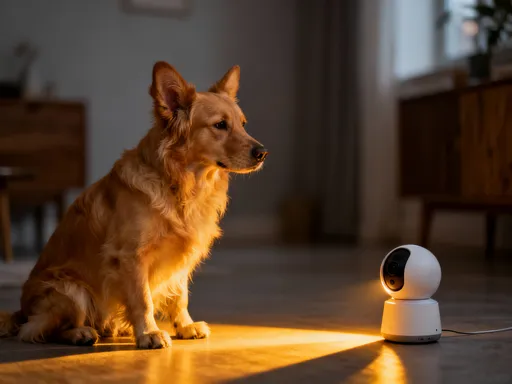
Then I found it. Not the fanciest, not the most expensive, but the one that made my dog actually respond. The difference? It didn’t just play my voice—it preserved it. The audio was clear, warm, and most importantly, immediate. No lag, no distortion. It used directional speakers that focused the sound toward her usual spot on the rug, so it felt like the voice was coming from nearby, not from inside the walls.
But the real game-changer was the light cue. Before I spoke, a soft, warm glow would spread from the base of the camera—no flashing, no beeping, nothing startling. Just a gentle signal, like sunlight shifting across the floor. I started using it before saying anything, pairing it with a treat at first. Within days, I noticed something amazing: as soon as the light came on, her ears would lift. She’d turn her head toward the camera before I even opened my mouth. That anticipation—her waiting for me—was the first real sign that she wasn’t just hearing me. She was expecting me.
One morning, I watched her lie down after breakfast, eyes half-closed. The app suggested a check-in based on her routine. I triggered the light, waited two seconds, then said softly, ‘Hi baby. You’re doing great.’ She opened her eyes, stretched, and wagged her tail once—slow and content. Not an excited frenzy, but a calm acknowledgment. That was the moment I knew: this wasn’t just a camera. It was a bridge.
How It Works: Designing Tech Around Pet Behavior
What made this camera different wasn’t just the hardware—it was the thinking behind it. Instead of cramming in features, the designers seemed to ask: ‘What does the pet need?’ The microphone adjusted for background noise, so if the dishwasher was running, my voice would automatically get a little louder and clearer. The speaker mimicked the warmth of human speech, not just the words. Even the app was built around her rhythms, not mine.
The app learned her patterns over time. It noticed she usually settled down around 10:30 a.m., so it would gently suggest, ‘She’s likely resting now—try a quiet hello.’ I followed the prompt, spoke softly, and sure enough, she lifted her head and looked right at the camera. Another time, it said, ‘She’s been up for a while—maybe a treat and a cheerful greeting?’ I did it, and she trotted over, tail high. It wasn’t mind reading. It was thoughtful design—technology that paid attention to her, not just to me.
And because the system learned, it got better over time. It started recognizing when she was stressed—like when she paced or barked—and would suggest calming phrases or play a recorded message I’d pre-saved. I could record my voice saying, ‘It’s okay, sweet girl,’ in my most soothing tone, and trigger it remotely. No shouting, no panic. Just calm, familiar reassurance. For the first time, I felt like I could actually help her, not just watch her struggle.
Real-Life Moments: From Barking Fits to Calm Reassurance
The real test came during a thunderstorm. I was stuck in traffic, rain pounding the windshield, when I remembered—my dog hates thunder. I opened the app, heart racing, expecting the worst. And there she was: under the coffee table, body tense, eyes wide. A crack of lightning flashed, and she flinched, letting out a low whine.
Old me would’ve just watched, helpless, until I got home. But this time, I acted. I triggered my pre-recorded message: ‘It’s okay, baby. I’m here. You’re safe.’ My voice, calm and clear, filled the room. She froze. Then, slowly, she turned her head toward the camera. Another boom of thunder—and she didn’t dive deeper. She sat up. Looked at the camera again. Then, with a soft huff, she got up and walked back to her bed. She didn’t curl up in fear. She lay down, head on paws, watching the room.
I sat in my car, tears in my eyes. That moment wasn’t about tech. It was about presence. I wasn’t there, but she knew I was with her. The camera didn’t fix the storm, but it gave her something stronger: a sense of connection. It turned a moment of panic into one of comfort. And that, more than any feature list, is what I had been searching for.
Tips for Making It Work in Your Home
If you’re thinking about trying a smart pet camera—or you’ve tried one that didn’t work—here’s what I learned. First, start small. Don’t blast your voice the second you log in. Begin with the light cue alone, paired with a treat or a favorite toy. Let your pet make the connection: light = good thing coming. Do this for a few days, even if it feels silly.
Next, keep your messages short and calm. Instead of ‘HELLO BABY DO YOU SEE ME??’ try a soft, ‘Hi sweetie. Just checking in.’ Use the same phrases every time. Dogs thrive on routine, and consistency helps them recognize your voice as a signal of safety. I used just two: ‘Hi baby’ and ‘Mom’s here.’ That’s it. Simple. Predictable. Reassuring.
Timing matters, too. Don’t interrupt naps or meals. Wait for natural pauses in their day. The app I used helped with this, but you can also just observe. If your dog is relaxed, that’s the perfect moment to connect. And don’t overdo it. One or two check-ins a day are enough. It’s not about constant monitoring—it’s about meaningful moments.
Finally, let your pet lead. If she ignores the light at first, don’t force it. Try a different time, a different tone, a different treat. Watch her body language. When her ears perk up, when she turns toward the camera, that’s your win. Celebrate it. That’s the start of real communication.
More Than a Gadget: Strengthening the Bond When You’re Apart
This camera didn’t just ease my guilt about leaving. It changed how I think about being away from my dog. I used to worry that every hour apart was a missed moment, a break in our bond. But now I see that connection isn’t just about physical presence. It’s about emotional availability. Knowing she can hear me, recognize me, and feel calmer because of it—that’s powerful.
It’s not about controlling her behavior or spying on her. It’s about being there in a way she can understand. It’s about saying, ‘I see you. I’m here. You’re not alone.’ And when she responds—when she turns, wags, settles—that’s not just a reaction. That’s trust. That’s love.
For anyone who’s ever looked at their dog’s sad face before walking out the door, or come home to find chewed shoes and a guilty look, I get it. We want to do better. We want to be there, even when we can’t. This technology isn’t flashy. It won’t win design awards. But it’s faithful. It shows up, day after day, and helps maintain the bond we work so hard to build. And sometimes, in the quiet moments between a soft light and a gentle voice, that’s exactly what love needs.